This Article is about my Experience in participating Hackathons.
Hackathons are an exciting way to learn, build, and innovate, often in a high-energy environment surrounded by like-minded people. Whether you’re a student, developer, designer, or entrepreneur, hackathons can help sharpen your skills, grow your network, and even launch a career or startup idea. But how exactly do you find these events, and what’s the best way to participate? Here’s a guide to get you started.
1. What Is a Hackathon?
A hackathon is a time-bound event (usually 24–72 hours) where individuals or teams collaborate intensively to create software or hardware solutions. These can be competitive or collaborative, online or in-person, and span various themes like health tech, fintech, education, AI, and social impact.
2. Where to Find Hackathons
There are several platforms and communities where hackathons are regularly hosted:
- Devpost (devpost.com): One of the largest platforms listing both online and in-person hackathons.
- Luma: Visit the Discover Section and Search for Hackathons.
- Unstop: Very Popular Platform in India. Go to Competition Section, Then go to Hackathons.
- MLH (Major League Hacking): Popular among students, MLH runs a seasonal league of hackathons across universities.
- Hackerearth & Hackathon.com: Great for professionals and companies looking to join innovation challenges.
- Eventbrite & Meetup: Local tech meetups and startup events often host hackathons.
- Dorahacks: Mostly Web3 and Blockchain related Hackathons.
- University & College Clubs: Many educational institutions hold internal or intercollegiate hackathons, check with your computer science or entrepreneurship club.
My Personal Hack to Find Hackathons: I use X/Twitter to search for Hackathons and then go to Latest Section to know about any new Hackathons being Organised. Half of the Hackathons I won, got to know by Twitter/X. Also I ask Grok to find hackathons that are posted in X.
3. Choosing the Right Hackathon
Pick a hackathon that matches your interests and skill level. If you’re new, choose beginner friendly or learning-focused events. Look for themes that excite you like sustainability, gaming, health, or AI and check if the event provides mentors or workshops. Even if you get Stuck somewhere you will be getting Help.
4. Register and Prepare
Once you find an event:
- Sign up early. Spots can fill fast.
- Read the rules and guidelines. Understand what’s expected.
- Form or join a team. Many platforms help connect solo participants but if you are willing to try Solo, Do it.
- Brush up on your skills. Depending on the theme, you might want to review relevant programming languages, APIs, or tools.
- What to Bring or Set Up. For in-person hackathons: Bring your laptop, charger, snacks, and maybe a sleeping bag. For online hackathons: Ensure a stable internet connection and access to required software or tools. Set up a workspace that allows focus and minimal distractions.
5. Building Your Project
Once the hackathon starts:
- Ideate quickly. Start with a problem worth solving. I repeat: problem worth solving.
- Plan before coding. Sketch your idea, decide roles, and split the work if working in a team.
- Build iteratively. Focus on a working prototype, not perfection; initially Build a MVP.
- Ask for help. Use mentors and community channels to solve roadblocks.
- Use AI. Use AI if Necessary.
6. Submit and Present
Most hackathons require a demo, short video, or pitch:
- Keep it simple. Show how your solution works and solves a problem.
- Stick to time limits. Practice your presentation in advance, if it requires.
- Highlight impact and creativity. Judges love originality and practical use cases.
Case Study
Multilingual Hackathon - Why Some Projects Won (and Others Didn’t)
One of the most interesting learning experiences from my hackathon journey was during the Multilingual Hackathon #2, where my project Etymo secured 🥉 3rd place.
What made this hackathon special wasn’t just the competition - it was understanding how judges actually evaluate projects. After the results were announced, judges openly explained why certain projects ranked higher while many technically strong submissions didn’t win. This became a valuable case study on hackathon judging psychology.
So, the Winning Projects were…
- 🥇 Cultural Context Adapter: Focused on adapting language based on cultural meaning, not just translation.
- 🥈 NutraLingo: Applied multilingual AI to the nutrition domain, solving a practical real-world problem.
- 🥉 Etymo (My Project): Explored word origins and linguistic understanding to improve multilingual learning.
Interestingly, the score difference between 2nd and 3rd place was just one mark, showing how small positioning differences can impact final rankings.
❓ The Big Question Participants Asked
Many participants felt disappointed because their projects had strong backend systems and complex implementations. One common concern was:
“Why didn’t judges check my backend?”
The judges clarified something crucial: 👉 If a feature is not clearly shown in the demo or README, it effectively does not count during judging.
Hackathons are fast-paced evaluations. Judges rarely run full repositories, they evaluate based on:
- Demo clarity
- Problem statement
- Innovation perception
- Real-world usefulness
🧠 Two Key Judging Criteria: Originality & Utility
✅ Originality
Originality measures whether the idea feels new. Judges mentioned that projects like:
- Article summarizers
- Translation tools
- Chat translators
- Figma translation plugins ...appear in almost every hackathon. Even if technically impressive, repeating common ideas reduces scores because judges have already seen similar solutions many times.
Lesson: Hackathons reward new perspectives, not just better implementations.
✅ Utility
Utility answers a simple question: If this product existed today, would people actually use it? Projects lose points when:
- Similar popular tools already exist
- The solution doesn’t solve an urgent problem
- Users have no strong reason to switch
Winning projects demonstrated clear real-world adoption potential.
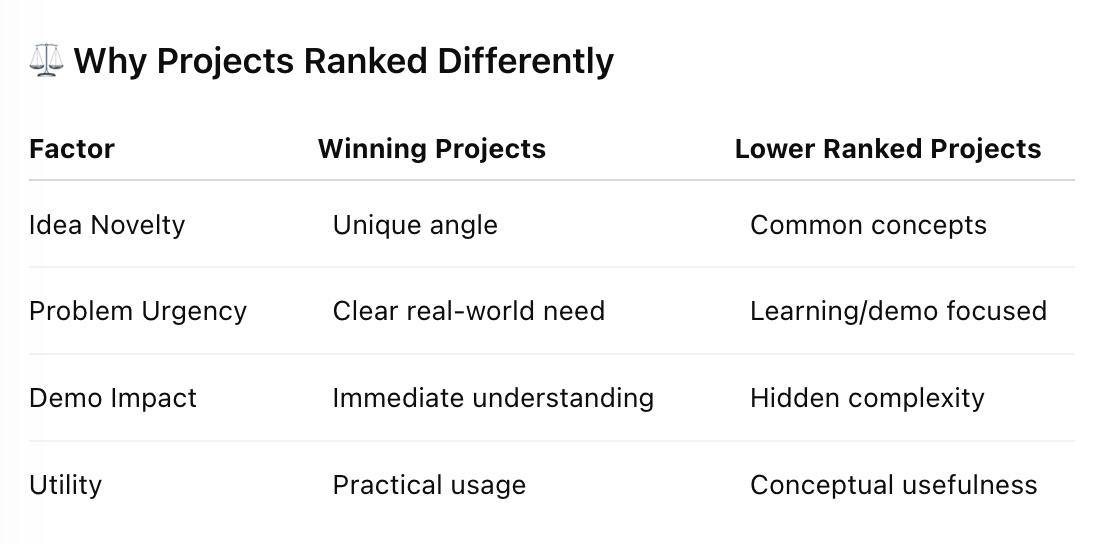
The difference often wasn’t coding skill - it was how convincingly the problem was positioned.
🚀 Key Takeaway From This Hackathon
Hackathons are not engineering competitions - they are idea positioning competitions. A project wins when judges can instantly understand:
- Why the problem matters
- Why the solution is different
- Why people would actually use it
Innovation isn’t just about building something new - it’s about making people immediately see why it matters.
7. After the Hackathon
Win or lose, don’t stop there:
- Polish your project. Turn it into a real-world product or portfolio piece.
- Stay in touch. Connect with teammates, judges, and fellow hackers.
- Reflect on the experience. What did you learn? What could you do better?
Final Thoughts
Hackathons are more than just competitions - they’re learning accelerators and gateways to collaboration. Whether you’re looking to test your skills, meet new people, or build something meaningful, participating in hackathons can be a game-changer. Start small, stay curious, and embrace the creative chaos. Your next big idea might just be a hackathon away.